


Fresh, clean, cool water… so far so good!
Amphora, Urn, Pot For Water Purification, Detox, Conditioning And Energising
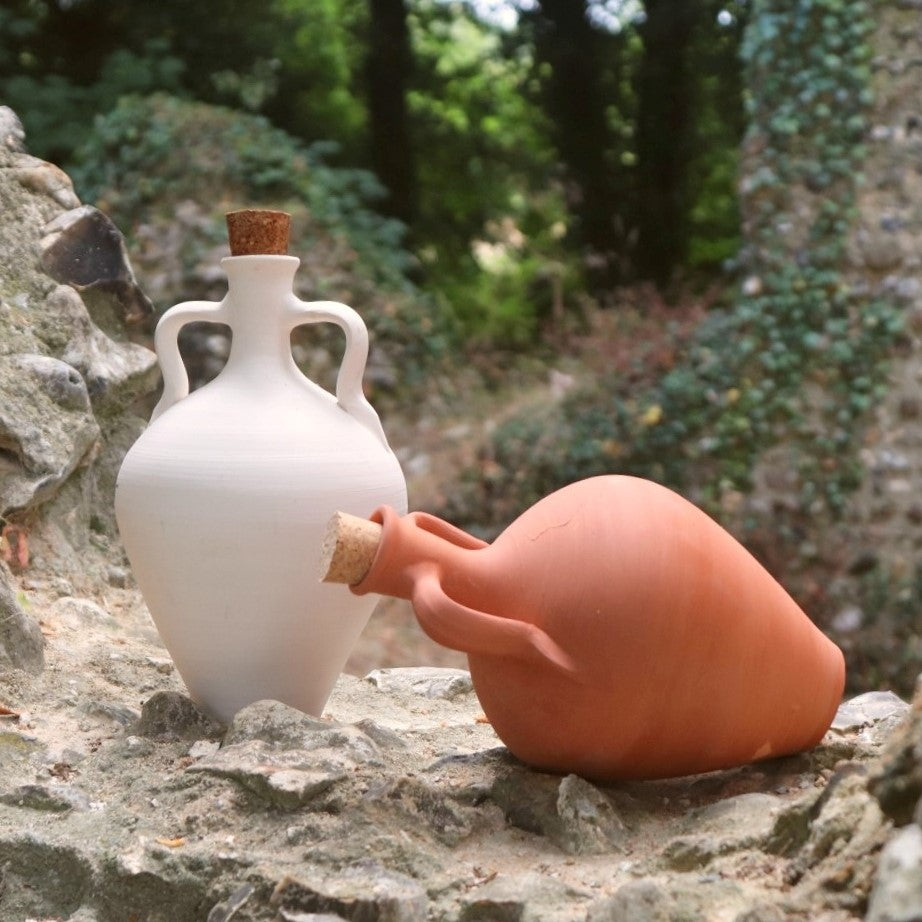


Amphora pots are the most natural water purification system to detox, purify and energise your tap water with a stunning handmade traditional terracotta red or white clay Amphora in either 1, 2, 5, 7 or 25 litres.
Natural water purification: Purify tap water the traditional way – forever plastic free. Make ‘spring-like’ water in your own home from tap water in a time-tested clay amphora. Provide delicious, pure water for your family, friends, pets and plants.
These traditional handmade amphorae are not only beautifully proportioned and finished, but they transform the quality, aroma and taste of tap water. Available in a range of sizes, they are supplied with either a cork ball or a cork bung. Create the healthiest, freshest tasting and most energised water without using replacement cartridges or filters and receive your amphora in our plastic-free packaging. Available in natural terracotta red or natural white clay.
We recommend using tap water in the amphora. Tap water is generally bacteria-free and much lower in microplastics than bottled water. It is cheap and you don’t have to carry it around. However tap water can contain contaminants such as chloride, fertilizer, pesticide fragments and heavy metals. Improving tap water has previously involved water filter jugs with over-engineered plastic cartridges or using expensive home installations which can strip all of the minerals out of the water. So that is the main reason to use a clay amphora specifically designed for natural water purification. However, tap water can be improved using low-tech, ancient techniques such as practised by the Romans using clay amphorae and at Natural Spa Supplies we think that this is the most practical, zero energy and planet friendly natural water purification system.
Tests on our amphora have shown that they do perform natural water purification. They purify, detoxify, condition and energise tap water.
These classically styled amphorae have been made to order by a fourth generation potter in clay. Each amphora comes with either a tapered cork bung or a cork ball. Please select according to your preference. You will need to provide your own ceramic or glass bowl to stand the amphora in.
Our laboratory tests on water which has been conditioned in our traditional clay amphora overnight have produced exciting results.
Water conditioned in our amphora overnight (8 hours) is 100% potable i.e. there is no migration of undesirable elements from the body of the amphora into the water. Please don’t just use any old clay pot for conditioning your water – some clays contain fungicides, others leach heavy metals and fluorides or contaminants from the firing process. Establishing that the clay from which our pots are made from is safe formed the foundation of our tests.
Using a natural water purification Amphora for the Reduction of Contaminants in Tap Water
Although some of the nitrates occur naturally in water, levels in aquafers and rivers are increasing due to fertilizer use and sewerage run off – consequently levels can be high in tap water. Nitrates can also be very high in well water and this is why so many wells are no longer in use. High levels of nitrates can pose numerous health hazards, particularly during pregnancy and in young infants and can be a cause of thyroid disfunction in adults.
On average our tap water is pH 7. Water which had been conditioned in the amphora overnight showed an increase in alkalinity to pH 7.8. Scientifically minded customers will know that the pH scale is logarithmic, and so this represents a large increase. Alkaline water is much better for us.
Bacterial colony counts were also kept lower in the amphora than in untreated tap water. Water from the tap should be free of the bacteria, however, colonies do appear over time. On average tap water forms 1 colony of bacteria at 22 degrees Celsius over 3 days and 3 colonies at 37 degrees Celsius over 2 days. Water conditioned in the amphora overnight showed less than 1 colony at on days 2 and 3. Water conditioned in the clay amphora shows none of the following bacteria at all: Coliforms, Eschererichia coli, Enterococci or Sulphite reducing Clostridia.
WHO recommends that filtered and chlorinated water be purified in clay pots in Africa to eliminate chloride-resistant bacteria, but they leave it in the pot for 2 days. If you think that you have bacteria in your tap water you should boil it and contact your water board. Contamination is surprisingly frequent.
The amphora-conditioned water is more energetic and carries more electrical charges – the conditioned water saw a rise in conductivity from 698 to 742 uS/cm. The result indicates that the conditioned water is richer in electrolytes. By contrast, reverse osmosis and distilled water carry very low electrical currents and water treated to reduce conductivity is not as healthy for us and not considered fit for drinking.
The main increase of minerals in the amphora-conditioned water was in magnesium. Magnesium is important for heart and circulation health and its bioavailability is greater in water than in food. Please note, the amphoras do not soften tap water.
Amphora purified water tastes clean, refreshing, pure and cool. Whether you see these amphorae as purely functional or as showy decorative urns, they always look gorgeous and they are suited both modern and historical settings. When the pot is filled to the base of the neck, the water is contained within the egg-shaped belly of the pot. The egg shape is the ideal flow form for the circulation of liquids in nature. Within this shape water follows its natural motion, moving in curves and spirals which aids natural water purification.
The hotter the weather, the greater the ability of the amphoras to cool water. An experiment conducted on the 1 litre amphora, showed that indoor when the room temperature was 23°C the water inside the amphora was at 19°C when the amphora was taken outside, the external temperature was 41°C the water from inside the amphora measured 22°C. The amphora is almost like a natural refrigerator, reducing the temperature of the water by 19°C. All without using expensive electricity!
There is some suggestion too, that following these natural flow forms, clusters of water molecules reduce in size: customers report that the amphora-conditioned water feels more liquid in the mouth, more refreshing in the stomach and overall more hydrating.
Now your amphora is ready to use.
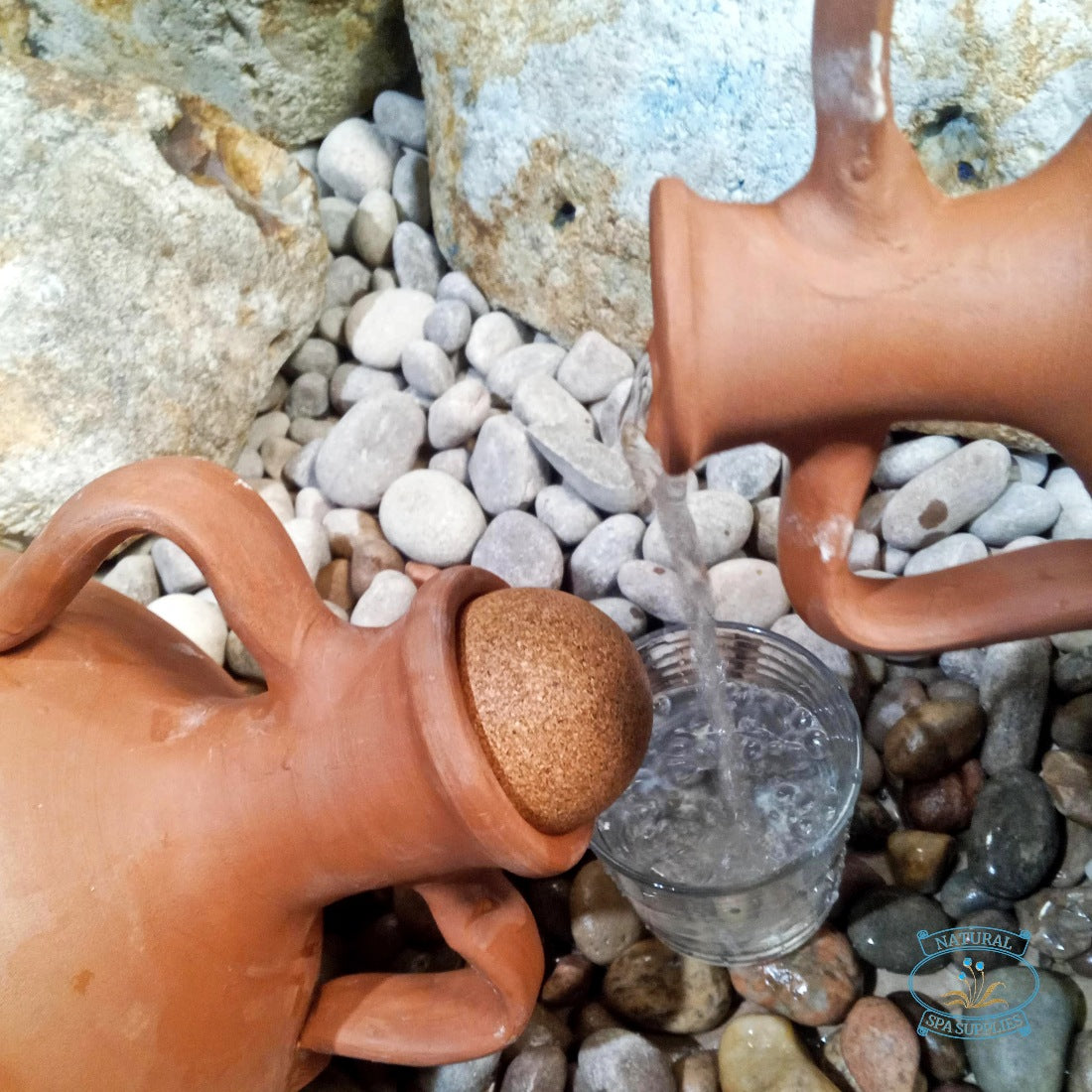
Fill the amphora up to the base of the neck with water with tap water, replace the cork and allow it to purify, condition and energize over 8 hours or longer depending on the quality of your tap water. Only drink the water from inside the amphora. Discard any water which has collected in the bowl. Our tests were conducted on water which had been conditioned in the amphora for 8 hours. So you will be able to re-fill each amphora 2-3 times per day. Once the water is conditioned, pour the water from the amphora into your kettle or glass jug. Never place a ladle or your hands inside the amphora or it will introduce microbes. Each time you refill the pot, empty out any water which has accumulated in the bowl. Check the amphora daily to make sure that there is no mildew growth on the outside of the pot. Periodically the pot will need cleaning as residues and dust will accumulate on the outside of the amphora. Other than rinsing with water, the pot should never be cleaned on the inside. The inside of the pot is self cleaning. Pots which are designed in Africa to purify and store drinking water are designed so that you can’t get a hand or ladle inside them and this is exactly what the World Health Organization (WHO) recommends. This way the interior of the pot can remain bacteria free.
If the pot has accumulated deposits on the outside, you will need to clean your amphora straight away. How frequently you need to clean the amphora will vary with your water quality, the weather, how you heat your house, where your pot is kept etc.
Empty the pot and rinse the inside with fresh water. It is best to clean the outside of the pot with a Scrubby and homemade Soapnut liquid. If there are lots of limescale deposits, you can fortify the soapnut liquid with the addition of Citric Acid. Never use conventional washing-up liquid, household cleaners or any oil-based soap as they can contaminate the amphora and clog the pores in the clay body. Do not expect to be able to remove all of the limescale deposits from the outside. Please refer to the first photo on this page and the video, so see how the outside of the amphora appears once it has been used for some time.
You can see in this 'How to Clean Your Clay Amphora' video just how effective the soapnuts, scrubby and citric acid are, even against mildew.
| https://youtu.be/dMZK92cOdew?si=1QXRgf04o7mRh6tn |
Scrub the cork with a clean Scrubby and Soapnuts and Citric Acid as above. Then place the cork in a vegetable steamer and steam it for 3-5 minutes. The cork will be sterilized. It is soft and wet when you take it out of the steamer. Let it dry before replacing it in or on the amphora. The amphora is ready for reuse.
Start by cleaning the amphora as above and covering the opening with a clean handkerchief, a clean piece of muslin, or a piece of newspaper, secured with a rubber band. This is so the amphora can breathe. Leave the amphora outside on a clean surface on a dry, calm and sunny day – for several hours. Turn the amphora part way through the day so the sun can reach both sides of the body of the amphora and so that the clay body of the amphora can naturally heat up and expand. This helps to open the pores of the clay body and refreshes the amphora. After the sunbath, the amphora is ready for immediate reuse for natural water purification. The pots do appreciate consideration and good care. In return, it will happily provide you with up to many litres of purified water per day – well apart the odd day, when you are cleaning it! Please try not to drop your pot, bash it into a tap, or knock it over. Please keep up a good cleaning schedule.
Hold both arms (handles) when lifting the pot and setting it down and use a balanced and controlled stance at all times. Or hold one arm and support the base. Do not hold the pot by the mouth. The amphoras have a well-designed neck which pours well.
| Size of Amphora | Unit of Measure | Circumference | Height |
| 1L | inches | 17 | 9 |
| cm | 43 | 23 | |
| 2L | inches | 21.5 | 11 |
| cm | 54 | 28 | |
| 5L | inches | 27.75 | 14.5 |
| cm | 71.5 | 37 | |
| 7L | inches | 34.5 | 16 |
| cm | 88 | 40 | |
| 25L | inches | 42 | 22 |
| cm | 107 | 56 |
Please note, these sizes and weights are approximate - each amphora is handmade. Please also be aware that some amphoras will contain 'markers marks'. Each amphora starts off as a ball of wet clay which is turned on the potter's wheel. Once the amphora has been formed, it must be removed in its wet state onto a rack to naturally dry before being placed in the kiln. The potter is very experienced, but imagine moving a slippery amphora of heavy wet clay without deforming the pot - it is quite a challenge. As the wet unbaked amphora is moved, sometimes a thumb mark, or some other impression is left on the body of the clay. We do not consider these to be defects - they add the individuality of the amphora. None of these surface marks effects the performance of the amphora in any way.
We are now having some of amphoras made from white clay. These are available in 1L, 2L and 5L sizes.
Just select the size and whether you would like the tapered cork bung or the cork ball. Free postage is available on all UK orders. Do consider getting some Scrubbies, Organic Soapnuts and Citric Acid too, so you can easily keep the amphora clean and not be tempted to use unsuitable cleaners on it!
If you are not in mainland UK and would like one the 2L, 5L, 7L or 25L amphorae, please email us first – we need to make sure we have the right packaging on hand before you place your order and we will need to give you a bespoke shipping quote. If you are in the EU, or abroad, please be aware that there will be customs charges and possibly other duties and that responsibility rests with you!
Enjoy drink fresh tasting, cool, detoxified and energized water. We invite you to conduct your own ‘blind’ taste/aroma/texture tests with your friends between freshly drawn tap, or tap water purified through other means with the water which you have conditioned in your amphora!
Please note in the interests of hygiene we can not accept the returns of used amphoras.
Yes, save yourself the trouble of lugging bottles of water back from the supermarket. Just fill up your pot and leave the water to purify overnight. You can use it for kefir production, kombucha nurture, home brewing, fermentation brines, making detox teas, herbal infusions and a superior cup of tea!
The differences are mainly aesthetic.
No, please empty the amphora and leave the cork off or ajar so that air can circulate on the inside.
Yes, you can. We have established that the water inside the amphora remains bacteria-free for 3 days when the ambient temperature is at 22 degrees Celsius and 2 days at 37 degrees Celsius. The water will begin to taste more of clay - some customers leave the water in the amphora for longer than 8 hours because they prefer the taste.
We make our own packaging by shredding used cardboard onsite. You can use the packaging again or use it as garden mulch?
If you live in a hard water area, you will see white deposits on the outside of the amphora, even after cleaning. This is normal with terracotta and does not effect the function of the amphora.
Be aware that the amphora will also cool the water. So do check the temperature before using it, to make sure it is in the range of your yeast. Or add the water straight onto the fruit and wait for it to achieve the right temperature before you add the yeast.
Yes, as well as performing natural water purification, the amphora will add some minerals back to the distilled water and make it healthier to consume.
https://youtu.be/dMZK92cOdew?si=ekYDC2y_68jUyhPR
First of all, find a new location for your amphora. There needs to be more air flow and the air needs to be dryer. So please move the amphora to a better location. Please use the method in the video above, using Soapnut liquid, Citric Acid and a Scrubby. If any signs remain, rub the amphora with fine sand paper or use clean sand and a Scrubby to sand off the surface. A combination of all of these can be helpful to remove thick deposits of limescale.
Amphora pots are the most natural water purification system to detox, purify and energise your tap water with a stunning handmade traditional terracotta red or white clay Amphora in either 1, 2, 5, 7 or 25 litres.
Natural water purification: Purify tap water the traditional way – forever plastic free. Make ‘spring-like’ water in your own home from tap water in a time-tested clay amphora. Provide delicious, pure water for your family, friends, pets and plants.
These traditional handmade amphorae are not only beautifully proportioned and finished, but they transform the quality, aroma and taste of tap water. Available in a range of sizes, they are supplied with either a cork ball or a cork bung. Create the healthiest, freshest tasting and most energised water without using replacement cartridges or filters and receive your amphora in our plastic-free packaging. Available in natural terracotta red or natural white clay.
We recommend using tap water in the amphora. Tap water is generally bacteria-free and much lower in microplastics than bottled water. It is cheap and you don’t have to carry it around. However tap water can contain contaminants such as chloride, fertilizer, pesticide fragments and heavy metals. Improving tap water has previously involved water filter jugs with over-engineered plastic cartridges or using expensive home installations which can strip all of the minerals out of the water. So that is the main reason to use a clay amphora specifically designed for natural water purification. However, tap water can be improved using low-tech, ancient techniques such as practised by the Romans using clay amphorae and at Natural Spa Supplies we think that this is the most practical, zero energy and planet friendly natural water purification system.
Tests on our amphora have shown that they do perform natural water purification. They purify, detoxify, condition and energise tap water.
These classically styled amphorae have been made to order by a fourth generation potter in clay. Each amphora comes with either a tapered cork bung or a cork ball. Please select according to your preference. You will need to provide your own ceramic or glass bowl to stand the amphora in.
Our laboratory tests on water which has been conditioned in our traditional clay amphora overnight have produced exciting results.
Water conditioned in our amphora overnight (8 hours) is 100% potable i.e. there is no migration of undesirable elements from the body of the amphora into the water. Please don’t just use any old clay pot for conditioning your water – some clays contain fungicides, others leach heavy metals and fluorides or contaminants from the firing process. Establishing that the clay from which our pots are made from is safe formed the foundation of our tests.
Using a natural water purification Amphora for the Reduction of Contaminants in Tap Water
Although some of the nitrates occur naturally in water, levels in aquafers and rivers are increasing due to fertilizer use and sewerage run off – consequently levels can be high in tap water. Nitrates can also be very high in well water and this is why so many wells are no longer in use. High levels of nitrates can pose numerous health hazards, particularly during pregnancy and in young infants and can be a cause of thyroid disfunction in adults.
On average our tap water is pH 7. Water which had been conditioned in the amphora overnight showed an increase in alkalinity to pH 7.8. Scientifically minded customers will know that the pH scale is logarithmic, and so this represents a large increase. Alkaline water is much better for us.
Bacterial colony counts were also kept lower in the amphora than in untreated tap water. Water from the tap should be free of the bacteria, however, colonies do appear over time. On average tap water forms 1 colony of bacteria at 22 degrees Celsius over 3 days and 3 colonies at 37 degrees Celsius over 2 days. Water conditioned in the amphora overnight showed less than 1 colony at on days 2 and 3. Water conditioned in the clay amphora shows none of the following bacteria at all: Coliforms, Eschererichia coli, Enterococci or Sulphite reducing Clostridia.
WHO recommends that filtered and chlorinated water be purified in clay pots in Africa to eliminate chloride-resistant bacteria, but they leave it in the pot for 2 days. If you think that you have bacteria in your tap water you should boil it and contact your water board. Contamination is surprisingly frequent.
The amphora-conditioned water is more energetic and carries more electrical charges – the conditioned water saw a rise in conductivity from 698 to 742 uS/cm. The result indicates that the conditioned water is richer in electrolytes. By contrast, reverse osmosis and distilled water carry very low electrical currents and water treated to reduce conductivity is not as healthy for us and not considered fit for drinking.
The main increase of minerals in the amphora-conditioned water was in magnesium. Magnesium is important for heart and circulation health and its bioavailability is greater in water than in food. Please note, the amphoras do not soften tap water.
Amphora purified water tastes clean, refreshing, pure and cool. Whether you see these amphorae as purely functional or as showy decorative urns, they always look gorgeous and they are suited both modern and historical settings. When the pot is filled to the base of the neck, the water is contained within the egg-shaped belly of the pot. The egg shape is the ideal flow form for the circulation of liquids in nature. Within this shape water follows its natural motion, moving in curves and spirals which aids natural water purification.
The hotter the weather, the greater the ability of the amphoras to cool water. An experiment conducted on the 1 litre amphora, showed that indoor when the room temperature was 23°C the water inside the amphora was at 19°C when the amphora was taken outside, the external temperature was 41°C the water from inside the amphora measured 22°C. The amphora is almost like a natural refrigerator, reducing the temperature of the water by 19°C. All without using expensive electricity!
There is some suggestion too, that following these natural flow forms, clusters of water molecules reduce in size: customers report that the amphora-conditioned water feels more liquid in the mouth, more refreshing in the stomach and overall more hydrating.
Now your amphora is ready to use.
Fill the amphora up to the base of the neck with water with tap water, replace the cork and allow it to purify, condition and energize over 8 hours or longer depending on the quality of your tap water. Only drink the water from inside the amphora. Discard any water which has collected in the bowl. Our tests were conducted on water which had been conditioned in the amphora for 8 hours. So you will be able to re-fill each amphora 2-3 times per day. Once the water is conditioned, pour the water from the amphora into your kettle or glass jug. Never place a ladle or your hands inside the amphora or it will introduce microbes. Each time you refill the pot, empty out any water which has accumulated in the bowl. Check the amphora daily to make sure that there is no mildew growth on the outside of the pot. Periodically the pot will need cleaning as residues and dust will accumulate on the outside of the amphora. Other than rinsing with water, the pot should never be cleaned on the inside. The inside of the pot is self cleaning. Pots which are designed in Africa to purify and store drinking water are designed so that you can’t get a hand or ladle inside them and this is exactly what the World Health Organization (WHO) recommends. This way the interior of the pot can remain bacteria free.
If the pot has accumulated deposits on the outside, you will need to clean your amphora straight away. How frequently you need to clean the amphora will vary with your water quality, the weather, how you heat your house, where your pot is kept etc.
Empty the pot and rinse the inside with fresh water. It is best to clean the outside of the pot with a Scrubby and homemade Soapnut liquid. If there are lots of limescale deposits, you can fortify the soapnut liquid with the addition of Citric Acid. Never use conventional washing-up liquid, household cleaners or any oil-based soap as they can contaminate the amphora and clog the pores in the clay body. Do not expect to be able to remove all of the limescale deposits from the outside. Please refer to the first photo on this page and the video, so see how the outside of the amphora appears once it has been used for some time.
You can see in this 'How to Clean Your Clay Amphora' video just how effective the soapnuts, scrubby and citric acid are, even against mildew.
| https://youtu.be/dMZK92cOdew?si=1QXRgf04o7mRh6tn |
Scrub the cork with a clean Scrubby and Soapnuts and Citric Acid as above. Then place the cork in a vegetable steamer and steam it for 3-5 minutes. The cork will be sterilized. It is soft and wet when you take it out of the steamer. Let it dry before replacing it in or on the amphora. The amphora is ready for reuse.
Start by cleaning the amphora as above and covering the opening with a clean handkerchief, a clean piece of muslin, or a piece of newspaper, secured with a rubber band. This is so the amphora can breathe. Leave the amphora outside on a clean surface on a dry, calm and sunny day – for several hours. Turn the amphora part way through the day so the sun can reach both sides of the body of the amphora and so that the clay body of the amphora can naturally heat up and expand. This helps to open the pores of the clay body and refreshes the amphora. After the sunbath, the amphora is ready for immediate reuse for natural water purification. The pots do appreciate consideration and good care. In return, it will happily provide you with up to many litres of purified water per day – well apart the odd day, when you are cleaning it! Please try not to drop your pot, bash it into a tap, or knock it over. Please keep up a good cleaning schedule.
Hold both arms (handles) when lifting the pot and setting it down and use a balanced and controlled stance at all times. Or hold one arm and support the base. Do not hold the pot by the mouth. The amphoras have a well-designed neck which pours well.
| Size of Amphora | Unit of Measure | Circumference | Height |
| 1L | inches | 17 | 9 |
| cm | 43 | 23 | |
| 2L | inches | 21.5 | 11 |
| cm | 54 | 28 | |
| 5L | inches | 27.75 | 14.5 |
| cm | 71.5 | 37 | |
| 7L | inches | 34.5 | 16 |
| cm | 88 | 40 | |
| 25L | inches | 42 | 22 |
| cm | 107 | 56 |
Please note, these sizes and weights are approximate - each amphora is handmade. Please also be aware that some amphoras will contain 'markers marks'. Each amphora starts off as a ball of wet clay which is turned on the potter's wheel. Once the amphora has been formed, it must be removed in its wet state onto a rack to naturally dry before being placed in the kiln. The potter is very experienced, but imagine moving a slippery amphora of heavy wet clay without deforming the pot - it is quite a challenge. As the wet unbaked amphora is moved, sometimes a thumb mark, or some other impression is left on the body of the clay. We do not consider these to be defects - they add the individuality of the amphora. None of these surface marks effects the performance of the amphora in any way.
We are now having some of amphoras made from white clay. These are available in 1L, 2L and 5L sizes.
Just select the size and whether you would like the tapered cork bung or the cork ball. Free postage is available on all UK orders. Do consider getting some Scrubbies, Organic Soapnuts and Citric Acid too, so you can easily keep the amphora clean and not be tempted to use unsuitable cleaners on it!
If you are not in mainland UK and would like one the 2L, 5L, 7L or 25L amphorae, please email us first – we need to make sure we have the right packaging on hand before you place your order and we will need to give you a bespoke shipping quote. If you are in the EU, or abroad, please be aware that there will be customs charges and possibly other duties and that responsibility rests with you!
Enjoy drink fresh tasting, cool, detoxified and energized water. We invite you to conduct your own ‘blind’ taste/aroma/texture tests with your friends between freshly drawn tap, or tap water purified through other means with the water which you have conditioned in your amphora!
Please note in the interests of hygiene we can not accept the returns of used amphoras.
Yes, save yourself the trouble of lugging bottles of water back from the supermarket. Just fill up your pot and leave the water to purify overnight. You can use it for kefir production, kombucha nurture, home brewing, fermentation brines, making detox teas, herbal infusions and a superior cup of tea!
The differences are mainly aesthetic.
No, please empty the amphora and leave the cork off or ajar so that air can circulate on the inside.
Yes, you can. We have established that the water inside the amphora remains bacteria-free for 3 days when the ambient temperature is at 22 degrees Celsius and 2 days at 37 degrees Celsius. The water will begin to taste more of clay - some customers leave the water in the amphora for longer than 8 hours because they prefer the taste.
We make our own packaging by shredding used cardboard onsite. You can use the packaging again or use it as garden mulch?
If you live in a hard water area, you will see white deposits on the outside of the amphora, even after cleaning. This is normal with terracotta and does not effect the function of the amphora.
Be aware that the amphora will also cool the water. So do check the temperature before using it, to make sure it is in the range of your yeast. Or add the water straight onto the fruit and wait for it to achieve the right temperature before you add the yeast.
Yes, as well as performing natural water purification, the amphora will add some minerals back to the distilled water and make it healthier to consume.
https://youtu.be/dMZK92cOdew?si=ekYDC2y_68jUyhPR
First of all, find a new location for your amphora. There needs to be more air flow and the air needs to be dryer. So please move the amphora to a better location. Please use the method in the video above, using Soapnut liquid, Citric Acid and a Scrubby. If any signs remain, rub the amphora with fine sand paper or use clean sand and a Scrubby to sand off the surface. A combination of all of these can be helpful to remove thick deposits of limescale.
Overall rating: 4.8 / 5 from 65 reviews.
Fresh, clean, cool water… so far so good!
Amphora, Urn, Pot For Water Purification, Detox, Conditioning And Energising

Our water tastes less metallic with a more neutral smell, the water is kept cool but not cold, this was a great investment!! 😁
Amphora, Urn, Pot For Water Purification, Detox, Conditioning And Energising

Beautiful amphora, purified water tastes significantly better than tap water. Highly recommended!
Amphora, Urn, Pot For Water Purification, Detox, Conditioning And Energising

I love the amphora because the water tastes lovely and it keeps it cool even in this heatwave. I really appreciate that it purifies my water organically without having to replace filters etc. Thank you
Amphora, Urn, Pot For Water Purification, Detox, Conditioning And Energising

I couldn't believe it but the water tastes really fresh and delicious. I'm glad I found this great water amphora.
Amphora, Urn, Pot For Water Purification, Detox, Conditioning And Energising

I was a bit sceptical at first. However my partner bought one a couple of weeks before me so I experienced her products and was immediately impressed and convinced. The water is definitely much nicer to drink, makes my home made fruit smoothies a joy and my very weak cups of tea have never tasted better AND it looks great!
Amphora, Urn, Pot For Water Purification, Detox, Conditioning And Energising

Water's tasting lovely. My 2 other urns are still going strong, but this one certainly tastes great.
Amphora, Urn, Pot For Water Purification, Detox, Conditioning And Energising

Water inside this is different from the tap water as it tastes better and fresher. It has also a decorative effect in my kitchen which I like it so much. Thank you so much Natural Spa
Amphora, Urn, Pot For Water Purification, Detox, Conditioning And Energising

My second purchase, I love it. 🙏
Amphora, Urn, Pot For Water Purification, Detox, Conditioning And Energising

I’ve always been a passionate person about everything natural and healthy. I am very happy to have gotten this amazing Amphora. I can tell now with confidence that the water gets rejuvenated and alive once poured into it and left for a little while to get purified naturally. I’m grateful for Natural Spa people behind this amazing project, amongst others, and the expertise and passion put into their products, amphora in this case. I’d highly recommend this amazing jar. I’m proud to have owned one. I’ll be coming back for more products. Thank you very much:)
Amphora, Urn, Pot For Water Purification, Detox, Conditioning And Energising

I have 2 Amphoras now, a 2 litre and a 5 litre both white clay. Water tastes great, no nasty plastic filters, no electricity usage (I distilled water previously) and they look fantastic. Arrived super fast too.
Amphora, Urn, Pot For Water Purification, Detox, Conditioning And Energising

This shop is a real gem! With a good selection of cleaning products, it makes my natural living dream come true. My amphora is on the third day of preparation. The amount of water that sips out is increasing. Can't wait to try the naturally filtered water!
Amphora, Urn, Pot For Water Purification, Detox, Conditioning And Energising
I have recently and previously ordered amphora pots from Sally. The pots are beautiful and provide lovely purified water. The customer service is excellent and Sally goes above and beyond to help with any queries. It’s so lovely to find a company that cares about nature and all the goodness therein. Thank you Kamal x
Amphora, Urn, Pot For Water Purification, Detox, Conditioning And Energising
i love the shape and look, but I haven't actually used it yet. Too early.
Amphora, Urn, Pot For Water Purification, Detox, Conditioning And Energising
I love the water amphora. This is the second one that I have bought. I use the water for drinking (for me and my cats). The water has a nice taste and it's cleaner. I also use the water for kombucha brewing. Thank you for providing these great products and looking after the environment.
Amphora, Urn, Pot For Water Purification, Detox, Conditioning And Energising
I got this as a replacement, the old one cracked at the neck and broke off :( I have used them for a good few years, its quite unbelievable what rubbish seeps through the pot from tap water, the smell is quite appalling. The taste from the pot is so different from tap (ugh) its quite scary that people drink it on a daily basis???? I do not regret the day I started to use the amphora pot.
Amphora, Urn, Pot For Water Purification, Detox, Conditioning And Energising
items received on time and safely - following instruction sheet to get things going - all great - love the crystal clear water from the amphoras - highly recommend!
Amphora, Urn, Pot For Water Purification, Detox, Conditioning And Energising
got the amphoras - they are doing their thing in the kitchen - they arrived in good shape; the leaflet explaining how to use them was easy to digest, and yeah, i drink the water from INSIDE the amphoras as advised - i use the water for drinking and general misc... plants, washing, cooking, i like the fact that the water looks clearer from the amphoras; i follow the advice on the leaflet and all's well
Amphora, Urn, Pot For Water Purification, Detox, Conditioning And Energising
we are very pleased with the amphora. The water tastes wonderful
Amphora, Urn, Pot For Water Purification, Detox, Conditioning And Energising
I went down a size this time with the amphora.. And went from terracotta to white clay. I love it. Five litres is a perfect lifting weight when your being precise with pouring the water into a water jug. And it looks so elegant in white. I loved the terracotta and had a glazed bowl for standing it in that matched brilliantly. Now I'm on the hunt for something similar for the white amphora. When will you introduce metal stands? That would be great.
Amphora, Urn, Pot For Water Purification, Detox, Conditioning And Energising
The lovely water filter arrived quickly without breakages in cardboard packaging. I am still running water through before I start to drink from it.But I am very happy with it and look forward to the first taste. Thank you!
Amphora, Urn, Pot For Water Purification, Detox, Conditioning And Energising
I bought this one for a friend, having been using one a year or two myself. I wouldn't be without it. Water tastes so much better from the urn than straight from the tap.
Amphora, Urn, Pot For Water Purification, Detox, Conditioning And Energising
The amphora is a must for anyone who is on the path to understanding the true nature of water. Think Schauberger. Thank you.
Amphora, Urn, Pot For Water Purification, Detox, Conditioning And Energising
On first day there was strong smell of raw clay. But it disappeared by the second day and currently it has no smell to the amphora whatsoever. The first few times even after few days the water tasted a bit off if I did it only for 8h. So I chose to do 10-12h instead. For me it works better taste wise. Also even after left standing in my glass water jug the taste didn't change so I'm happy about this. Personally I tried various water filter jugs and even with glass jug there was still plastic for filter bit. Also after a while it just didn't taste the same anymore. I'm really fussy with my water and cant drink tap water due to disgusting taste. But so far I'm enjoying my water amphora. I purchased 2l one and find its plenty for my family. I will definitely recommend it to my friends and family. 5 stars.
Amphora, Urn, Pot For Water Purification, Detox, Conditioning And Energising
Very happy with it. Looks great, and the water tastes cool and clean. Many thanks!
Amphora, Urn, Pot For Water Purification, Detox, Conditioning And Energising
We love the amphora and would highly recommend this. I bought a second one as I have two dogs and they need their water bowls refreshed during the day so needed a second amphora. I chose this size as easy to fill and to pour .
Amphora, Urn, Pot For Water Purification, Detox, Conditioning And Energising
Amphora arrived lovingly packed. I chose white clay which goes slightly darker when full of water. Water tastes fabulous and seems to sparkle with aliveness. Took three days to commission (fill and replenish) before the water lost a slight taste of clay. Very happy to loose my plastic water filter with expensive cartridges that need more and more and increasingly frequent replacement. Also bought the scrubbiest which I love! Great company, great service. Wish I’d followed my friends recommendation sooner!
Amphora, Urn, Pot For Water Purification, Detox, Conditioning And Energising
This is my third amphora . My plants love the water and my dogs prefer it too . I use it for drinking but in particular for brewing puer . The older teas benefit from mineralisation
Amphora, Urn, Pot For Water Purification, Detox, Conditioning And Energising
Quick delivery Very pleased with the amphora Recommended to me by my friend
Amphora, Urn, Pot For Water Purification, Detox, Conditioning And Energising
Amphora 2L red I have bought the amphora as a present to a friend. The amphora is beautiful and sits comfortably under her kitchen cupboard. After initial cleaning, the water now tastes good. However, what was not expected is the amount of water being released in the pot. As she is not using the 2L in one day, it turns out that after 2 or 3 days, the water from the inside has completely emptied out in the pot below. Now she fills up only half of the amphora in order to limit the loss. This is not ideal. I wanted to get one for my plants but I am now reluctant. So not sure if this is a fault or if she does something wrong, but she has followed carefully the instructions that came with the amphora.
Amphora, Urn, Pot For Water Purification, Detox, Conditioning And Energising
It’s a bit on a heavy size and awkward to manipulate. I prefer the smaller bottles but otherwise it’s seem to work really well.
Amphora, Urn, Pot For Water Purification, Detox, Conditioning And Energising
It’s a good size and seems to work well.
Amphora, Urn, Pot For Water Purification, Detox, Conditioning And Energising
Takes a little perseverance to condition it for use but absolutley beautiful and worth it, does a great job of water purification, I keep it in my room and I refer to it as my temple water. I may have to get more for carrying with me outside
Amphora, Urn, Pot For Water Purification, Detox, Conditioning And Energising
The “purification” happens trapping the dirt INSIDE. In Africa they use clay pots trapping the dirt inside. I bought it at first believing what says on the site but after research realised it was bs. If we are provided with lab results I will change my review and start using the amphora to purify and hold the water that I drink. Now I’m sitting with an useless (but pretty) amphora in my room due to my impulsive purchase without the right due diligence.
Amphora, Urn, Pot For Water Purification, Detox, Conditioning And Energising
Really pleased. This has managed to steer our neurospicy teen away from single use plastic bottles. We all now have glass drinking bottles that are filled from the amphora, which tastes so much better than any other water we have had in the past. Looks great on the counter too :)
Amphora, Urn, Pot For Water Purification, Detox, Conditioning And Energising
Love the amphora the service was excellent .
Amphora, Urn, Pot For Water Purification, Detox, Conditioning And Energising
Have long been concerned about the water quality and got an Amphora after seeing the one that my cousin bought- she also has water impurities. The difference is incredible. Lovely pure water to drink. Thank you.
Amphora, Urn, Pot For Water Purification, Detox, Conditioning And Energising
Beautiful water that tastes refreshing and energising.
Amphora, Urn, Pot For Water Purification, Detox, Conditioning And Energising
I bought the white one a few months ago, but I found that the water didn’t seep through the amphora pores. So I bought the terracotta one and I much prefer it. Water tastes great in either of them but I feel the terracotta works better.
Amphora, Urn, Pot For Water Purification, Detox, Conditioning And Energising
Amphora is easy to use and makes drinking water taste pure and clear. It's a natural way to filter...no plastic.
Amphora, Urn, Pot For Water Purification, Detox, Conditioning And Energising
Plastic means trash. Only 9% of what you put in your recycling bin is ever actually recycled. We Avoid Plastic.
Our products breakdown naturally without harmful side effects to the Rivers and Earth. We Value Our Planet.
Our products are rigorously selected to be kind to sensitive skin and even allergy-prone skin. We Care For Your Skin.
We don’t merely add a green label onto our products and charm you with eco babble - we’re not into Greenwashing. We’re fully committed to eco living and we are the ‘Eco’ that big companies wish to be.