The only grade of clay recommended for brushing your teeth. Make your own DIY toothpaste with clay.
Green Clay
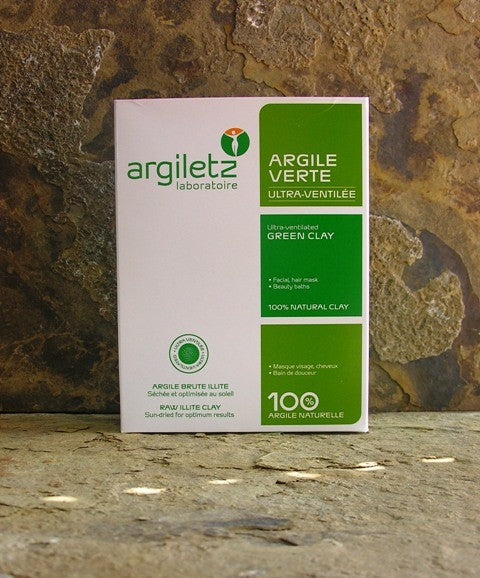
This French Green Illite Clay is 100% formed of minerals and trace elements. Clay replaces, shower gel, soap, face masks, facial make-up remover, mouthwash, toothpaste or as a massage or wrap medium. Use clay to simplify your dental routine to make your own clay toothpaste. Made by natural earth processes, this clay is finely ground and purified in air currents (ultra-ventilated) to yield the purest and smallest particles of clay.
Why do we need to detoxify our bodies?
Detoxification is not a human health fad. Animals in the wild practice regular detoxing. Wild animals want to feel good and have an intuitive and learned approach to the balance between what goes into their bodies (through the mouth or through the skin) and elimination. Many hairy mammals such as horses, elk, wild boar and deer roll in clay, elephants spray it over their bodies and hippos wallow in clay rich pools.
Humans have also practiced ‘detoxing’ throughout written history using a variety often ritually prescribed cleansing techniques. Many springs, synonymous with sources of clay have over the years been developed as open air spas and sites of religious awe. Structures associated with natural bathing have survived from the Bronze Age in Europe and you could argue that it is deeply within our psyche to wash with clay.
How does clay clean and detox the skin?
- Clay acts as a surfacent reducing water tension and dissolving impurities from the skin surface and skin pores.
- The negative electrical charge of the clay draws the lymph to the surface of the skin (you will see the skin go a paler colour). This is because most of the toxins contained by the lymph are positively charged. The clay then electronically attracts the toxins, drawing them through the skin and binding them to itself before it is washed away.
- The anti-microbial properties of the clay clean the skin leaving it hygienic and fresh. Clay is safe for washing intimate areas of the body.
- Clay mechanically exfoliates dead skin, especially when used with an exfoliating glove. Dead skin needs to be removed to prevent the blocking of pores and to enable the skin’s own moisturizer or sebum to penetrate the living cells, giving the skin flexibility and protection. A smooth, flake-free skin is more luminous and healthy looking and feel more comfortable.
- Clay users, especially when washing with an exfoliating glove often report that they have abandoned moisturizers as the skin does not seem so dry. We still encourage people to moisturize the face, neck, hands and nails with Argan oil, as these parts of the body are constantly exposed to the elements and need more protection.
- Using clay for washing, especially with an exfoliating glove stimulates the flow of blood and lymph encouraging a healthier better functioning skin.
- Did you know that our skin is supposed to eliminate 25% – 30% of our toxins? Some traditional health professional consider the skin to either akin to a third kidney or like an extra lung!
Why Make your Own Clay Toothpaste?
While commercial toothpastes clearly work, many of the common ingredients may actually cause some harm to the teeth, gums, oral tissues, throat and even stomach flora. Examples are fluoride, SLS and glycerine. When you make your own toothpaste, you can omit any ingredients you think are harmful and prioritize any ingredients that you feel will improve you oral health and hygiene. We mostly use the green clay just with water, but if you find it beneficial to add mouth friendly essential oils, powdered herbs, coconut oil you are welcome to tailor your own recipe!
The chief actions in the mouth are detoxing and remineralizing.
If you have (or have had) mercury fillings, well, clay has 1000s of year of anecdotal evidence of detoxing mercury and other heavy metals.
If you wish to remineralize the enamel, clay with a large array of minerals (the teeth do not just take up fluoride!) is reassuringly effective and has helped me with tooth sensitivity.
You can see how I make green clay toothpaste and how I use it on the video
https://youtu.be/imZgVY420YM?si=vsXSVrJ8K2OK-gF1
How to Make DIY Clay Toothpaste
I also make up a small amount of paste for brushing my teeth which I keep separately in a a small ceramic pot. Since I have stopped using regular toothpaste and floss I have stopped getting angular chelitis (the cracks at the corners of the lips) Could just be a coincidence!
I use 1 part of clay and just a smidgen more than 1/2 a part of water! I make up enough for a few day at a time to make sure everything is hygienic. I keep a lid on the toothpaste pot so it doesn't dry out. Sometimes I add a few drops of essential oil for a change, but mostly I prefer the very neutral taste of the clay. I can go seamlessly from toothbrushing to breakfast! I use the clay with my boar bristle toothbrush as the nature of the bristles gives superb cleaning action.
Directions for the Cosmetic Use of Green Clay
To make the clay power into a paste form, place a few tablespoons of green illite into a glass or wooden dish and add a little mineral or floral water. Leave to stand for a few minutes. Then mix well with a wooden spoon or spatula to obtain a smooth paste with consistency of soft butter.
Clay Paste
Use in place of soap and shower gel. Please try our eco-showering technique – Use about 2 minutes of hot water in the shower to wet and warm the body, then turn the shower off. Rub a spoonful of clay paste over the body using an exfoliating glove or loofah. Leave the clay for a while to prolong and deepen the detoxifying effect. Use about two minutes of hot water for rinsing. This uses much less water, some of which is taken by water authorities from underground aquifers formed about 10,000 years ago. These underground water sources are very slow to replenish. By using this eco-showering technique, there is much less water to heat, cutting down on carbon emissions and other pollutants, using less fossil fuel and reducing home energy consumption. While the shower is turned off, the clay is given a chance to act on the skin, detoxing and cleaning. Overall far less chlorine is inhaled and there is less chlorine exposure to the skin, reducing skin drying and irritation to the skin, eyes and respiratory system. We recommend Rhassoul Clay for hair washing.
The clay paste can also be used for washing the body in a bath or as a body scrub.
To remove facial make-up, wet the skin, then rub the skin with a few finger dabs of green clay using massaging motions. Rinse. Argan oil makes a superb eye and (oily) make-up remover - just 1 drop will suffice.
As a face and neck mask, secure the hair away from the face with a scarf or band, smooth the clay over the skin. To prolong the detoxifying action, cover the area with a damp cloth such as muslin or flannel, leaving the nostrils, eyes and mouth clear!
For a very deep facial detox, place the clay on the face and use a steaming technique: Heat 1 litre of water to nearly boiling point and pour it in a basin. Add herbs or essential oils which help your particular condition. Place your face over the basin and lay a towel over your face and shoulder allowing the steam to rise to the face. Keep your face at a comfortable distance over the hot water. Steam for 5-10 minutes and wash the clay mask off with cold water.
For wrapping a body part, place the clay directly on the skin and cover with a layer of wet muslin cloth or wet bandages. Cover with a piece of wool or a wool blanket to keep the body part warm. Leave for 30 minutes to 2 hours. Remove the cloth and peel the clay off into a bin. Rinse the skin and apply a cold pressed plant oil such as Argan oil to the body area. Never wrap more than 75% of the body. Wash the cloth afterwards.
You can make up enough paste to use for several days. Just assure that the paste does not dehydrate between uses by either keeping the clay paste in a jar with a lid, or by pouring a little extra water over the paste.
Slurry
Add more water to the powder, or paste to make a slurry – with the consistency of milk shake, as a face wash, or mouth rinse or foot bath.
Use either this consistency or the paste for body massage. Keep an extra bowl of water nearby, to keep the clay in the slip form, preventing drying or dragging. Rinse off with a bucket and sponge or in a shower or bath.
Powder
Hairy mammals like us nearly always use clay in its hydrated form. Furry mammals and birds, prefer clay in its powdered form. Humans can add a handful of clay powder into a relaxing and detoxifying foot bath, hip bath or fully body bath. If you ever use large quantities for a detox bath – anything from 200g to 1kg, then do not release the bath plug! Scoop the water and clay residue out with a bucket and pour it down the toilet (which has 4 inch drains).
WARNING
Keep out of reach of young children and pets.
Packaging
The clay is packed in a compostable paper bag and available in 100g, 200g and 300g bags.
Clay aficionados remove the clay from the packaging and transfer it to a clean and dry glass jar. They store their jar of clay powder in a dark place until they hydrate it and as it were bring it to life. Once the clay is hydrated clay enthusiasts energize it by leaving it in the sunlight, making sure that the clay does not desiccate.
Product Quality
- Guaranteed to be sun dried, non-ionised, and preservative free.
- Tested in 2009 in a meta-analysis showing that this ultra-ventillated clay is one of the safest clays in Europe. The brand is some 60 years old and it is the most revered and best published clay on the planet.
- Satisfies the levels of microbiological purity required by the European pharmacopoeia V.2.1.8
- This product has not been tested on animals, however it is believed that all, primates, all herbivores and possibly all vertebrates deliberately seek out clay for ingestion and for external use.
- This is the purest grade of clay – ultra-ventilated. To separate the micas from the clay, the powdered clay is blown up a curved tube. Heavier particles, such as micas and quartz remain at the base of the tube and only the lightest, finest and mica-free particles are collected as ultra-ventilated clay. The clay particles are very fine and have a huge surface area for detoxification.
- This clay is not ionised.
- The texture, colour and aroma of this particular clay is very pleasing. The taste is very neutral.
- Sun-dried. As clays form the smallest crystal in the world, the sun charges the particles with energy which is released when the clay is hydrated and applied to the skin.
- This is a raw and totally natural clay.
- Suitable for vegans.
Unfortunately vendors can no longer sell clay as a food supplement in the UK.